
The Public Good We Built
Why U.S. science matters, and what it will take to protect it


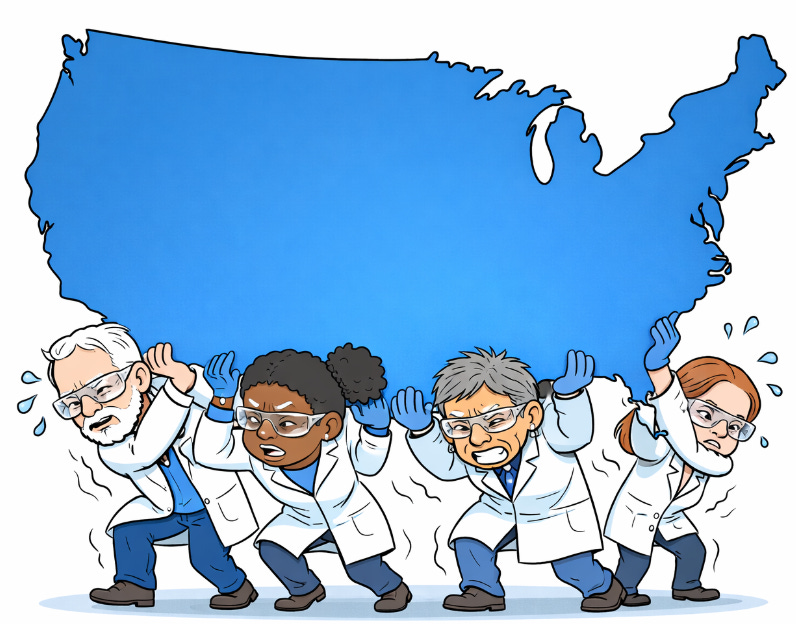
U.S. science is a public good.
We mean that in the broadest, most practical sense. It is a national system, not a single sector, and it includes government science, universities, nonprofits, contractors, hospitals and public health systems, and industry research. Government science is the backbone of that system. It measures our natural world, monitors public health and environmental risks, sets standards, tests products, forecasts and responds to natural disasters, maintains critical datasets, and develops evidence that shapes policy and protects the public from harm. Public funding also makes basic research possible, especially the long-term work that private markets often will not fund because the payoff is uncertain or diffuse.
This year, that system was attacked
Not just through budget cuts, but through political decisions designed to narrow what can be studied, who gets funded, what can be said, and what evidence is allowed to count.
In the federal government alone, the attacks came fast: mass staffing disruptions and reorganizations that hollowed out capacity; the dismantling of scientific offices (including the EPA’s move to eliminate its Office of Research and Development); and the rollback of scientific integrity policy that exist precisely to keep science from becoming politicized.
We also watched disinformation get laundered into official posture. In November, the CDC updated a vaccine safety webpage to claim that “vaccines do not cause autism” is “not an evidence-based claim,” reversing longstanding scientific consensus and treating a debunked talking point as something the government should platform.
And the administration has moved to unwind evidence-based public health and environmental protections and replace them with mechanisms that make it easier for politics to outweigh science. One concrete example: EPA’s proposal to rescind the 2009 Greenhouse Gas Endangerment Finding, the scientific and legal predicate for regulating greenhouse gas emissions, paired with a Department of Energy climate report widely criticized for false or misleading claims.
And it hasn’t stopped at the federal government.
The same pressure has been applied across the broader U.S. science ecosystem: universities have faced canceled or frozen research dollars and politicized funding conditions; and nonprofits and contractors that deliver research and public-health work have also been hit, forcing layoffs, program shutdowns, and self-censorship as organizations try to guess what language or topics will get their work flagged next.
So, when we say that this year has been a troubling year for science, we also mean that it has been a troubling year for the public good.
There is just no way around it. What we saw this year was not a routine debate about scientific priorities. It was pressure applied to the machinery that lets a country learn, measure reality, develop solutions, and correct course. When that machinery is treated as optional, the damage does not stay inside agencies or universities. It shows up downstream as worse policy decisions, slower responses to emergencies, and weaker public health and environmental safeguards.
Or in summary: a public forced to navigate more risk with less reliable information.
To understand what is at stake, it helps to remember why the United States built a public science enterprise in the first place, and why that choice made U.S. government science one of the most consequential national assets we have ever created.
How government science became national capacity
The modern U.S. science system did not appear by accident. World War II forced the federal government to treat science as a national priority and essential capacity; the results were decisive. After the war, the United States made a choice not to stand that capacity down.
In 1945, Vannevar Bush argued that sustaining scientific work in peacetime could advance health, security, and prosperity. The point was not that science is flawless. The point was that knowledge production and evidence-based decision-making are not luxuries. They are upstream of resilience, innovation, and the ability to govern competently.
That argument became architecture. Federal agencies and public funding helped build a system where government could do science directly, support science elsewhere, and use science to set policy. Over time, that architecture became something bigger than any single grant program. It became a shared civic capability. It is part of why the United States has been a crown jewel of science, not only because of discoveries, but because of the institutions and public policies that make discovery, measurement, and accountability possible.
What “public good” looks like in real life
When government science is working, most people barely notice it. That is not because it does not shape their lives. It is because they experience the benefits without seeing the infrastructure underneath. They see storm forecasts that help families get out of harm’s way. They see disease surveillance that flags outbreaks early. They see food safety standards and inspections that prevent contamination before it spreads. They rely on public datasets that let journalists, researchers, states, and communities check what is true. And they benefit from rulemaking where evidence has a seat at the table, and where the public can see how decisions were made and justified.
Basic research is part of that story, and it is worth defending on its own terms. Sometimes the clearest examples of “public good” start as questions that sound weird, niche, or pointless.
Take the Gila monster.

Researchers studying this venomous lizard identified compounds in its saliva that helped regulate blood sugar. That curiosity-driven work helped open the door to GLP-1 therapies, the medications now changing the lives of people with type 2 diabetes and reshaping care for obesity and related conditions.
No company builds a decade-long pipeline around “study lizard saliva” unless a public-good system exists to fund the strange upstream work. And what is striking is how the benefits keep branching. These therapies are not just a single breakthrough. They are a cascade. New indications, new trials, second-order benefits, and new questions that become answerable only because the original knowledge exists.
That is what government science, broadly, makes possible. It creates questions. It creates options. It creates tools. It creates the ability to reduce suffering, not just describe it.
Why this year felt different
So, when we say this year was chaotic, we are not talking about scientists feeling underappreciated, although many of us do. We are talking about the conditions that make government science function in public.
Science capacity is not just money. It is not just trust. It is staffing, continuity, protected data systems, strong scientific integrity policies, independent advisory processes, and a culture where civil servants and scientists can tell the truth without retaliation. It is the boring infrastructure that keeps scientific evidence from becoming propaganda and governance from becoming a performance.
This year, we saw too many efforts aimed not at improving government science but at weakening the conditions that allow evidence to be generated and used. You can call it reform if you want, but if the result is less independence, less transparency, less measurement, and more political control over what can be studied, communicated, or preserved, then we should name it honestly. That is not reform. That is sabotage with nicer language.
And sabotage does not just hurt scientists. It hurts everyone who depends on the outputs of government science, including public health, environmental protection, consumer safety, worker health, disaster response, and the economic measurements that shape decisions across the country.
Refuse despair
As we head into the new year, we have a few suggestions.
Our first is that we refuse to succumb to despair.
This is not sentimental. Despair is an outcome that benefits the people who want the public to disengage from reality-based governance. When people become convinced that nothing matters, they stop showing up. They stop voting. They stop serving on boards and committees. They stop mentoring the next generation. They stop defending institutions. The vacuum does not stay empty.
Refusing despair does not mean pretending things are fine. It means choosing persistence and stubbornness over paralysis. It means continuing to document what is happening, insisting on clarity, and translating “government science capacity” into stakes that non-specialists can recognize in their own lives.
Scientists need to engage
Our second suggestion makes some scientists uncomfortable, but it is this: we must engage.
Not as mascots. Not as partisan props. As citizens who understand how power works.
Government science is governed. Someone decides what gets funded, who gets appointed, what data stay in the public domain, what science boards and advisory panels exist, what integrity rules are enforced, and what happens to people who say inconvenient things out loud. Those decisions do not stop being political because we refuse to touch them.
“Staying above the fray” can feel like professionalism. In a moment like this, it is often withdrawal. Silence does not protect credibility. It protects the people who want control without accountability. Absence does not preserve neutrality. Absence hands the steering wheel to whoever shows up.
Engagement is not just Election Day. It is year-round civic presence. Writing, teaching, translating, organizing, testifying, mentoring, serving, supporting, documenting, and building relationships with communities and institutions that rely on government science.
If science is a public good, then public engagement is part of protecting it.
Rebuilding: Questions we cannot outsource
The last piece of the puzzle, and the one we want SciLight to spend far more time on in 2026, is rebuilding. Not restoring. Not going back.
If norms are treated as optional, then rebuilding has to be explicit. It has to be designed.
How do we regain and deserve public support without turning science into marketing or scolding? How do we help people understand, in plain terms, that government science is a public good that protects their health, safety, and economic security?
How do we communicate evidence in a world dominated by social media and disinformation, where false certainty spreads faster than accuracy, and outrage often outperforms nuance?
Where does AI fit into all of this? AI can accelerate discovery and widen access. It can also flood the information environment with synthetic persuasion and concentrate power in opaque systems. The promulgation of AI data centers is a huge environmental justice issue that is already disproportionately impacting underserved communities. What standards do we demand for communities? For transparency, auditability, and clear boundaries between assistance and deception?
What do we do about federal scientific capacity? Capacity is staffing, continuity, data systems, scientific integrity protections, and real safeguards against interference and retaliation. How do we protect long-term datasets and build redundancy so there is not a single point of failure when the next stress test arrives?
And if this happens again, how do we make sure the country is better prepared, not just emotionally prepared, but structurally prepared?
A way forward into 2026
We do not have to choose between realism and hope. Realism is what tells us the guardrails are not automatic. Hope is what we build when we choose to reinforce them, redesign them, and add the ones we should have had all along.
So here is our posture for next year.
We are going to treat government science as public service. We are going to keep naming interference when we see it, keep translating policy mechanics into real-world harm, and keep making the case that scientific capacity is part of what a functioning democracy looks like.
And we are going to get more constructive. Less simply documenting the damage, more publishing ideas for the blueprint. What does real scientific integrity protection look like in practice? What does data continuity require? What does a healthy and resilient workforce require? What standards should govern AI in the public knowledge ecosystem? What does engagement look like for scientists who were never trained for public-facing work, but who now cannot afford to stay silent?
If this year was about realizing how fragile the system can be, next year is about acting like stakeholders. That means showing up year-round. It means building civic muscle. It means refusing despair as a strategy. It means remembering that public science was built for the public good by people, and it can be rebuilt by people too.
We will see you in 2026. The work continues, and so do we.
That’s it for today - Thank you so much for reading SciLight!
If you enjoyed today’s post, please like it or share it with others. You can also support the work we do to shine a light on the politicization of science by becoming a paid subscriber!
If you want to share today’s post as a web page with your network, click this button:
If you have suggestions, questions, comments, or want to drop us a line - send it all to scilightsubstack@gmail.com
Brave and brilliant! May citizen in the US support your wise decision to speak up for the common good. Best wishes for a resilient and compassionate year ahead.
Thanks for this passionate and inspiring motivation.