
Science Left Behind: SciLight’s Inside Look at the Federal Brain Drain of 2025
Vacant leadership, mass firings, and the quiet dismantling of America’s scientific institutions.

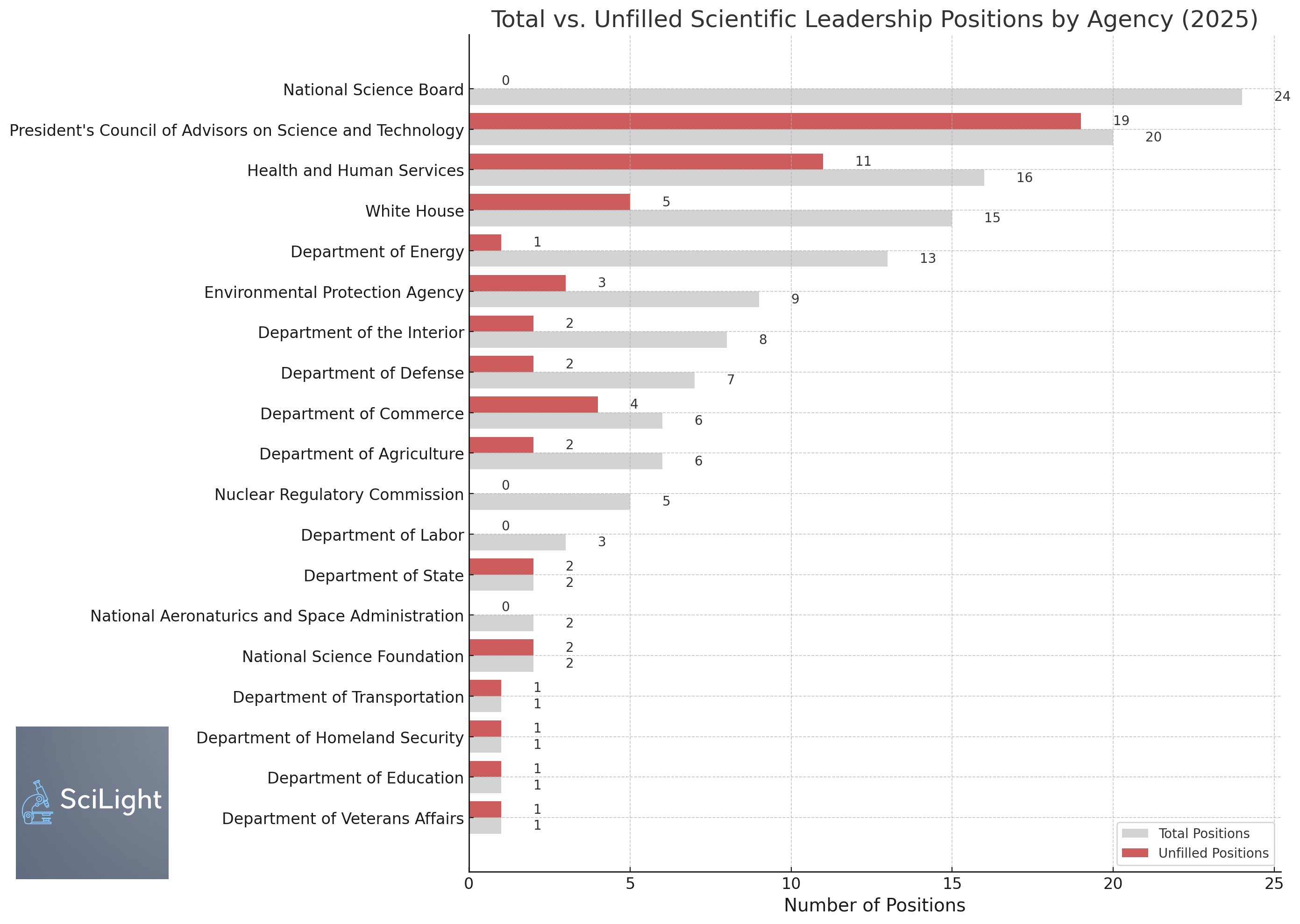
In the second Trump administration, the marginalization of science is not merely ideological—it is structural. The systematic sidelining of federal scientists is unfolding not just through hostile rhetoric or regressive policy, but through two mutually reinforcing strategies: the failure to fill key scientific leadership roles, and the large-scale dismissal of government scientists.
This picture is not speculative. It comes from SciLight’s Federal Scientific Leadership Tracker, which monitors nominations, confirmations, and statutory qualifications for top science and technology roles across the federal government. Of the 142 positions tracked, forty-percent (57 positions) remain vacant or without a nominee. Simultaneously, while we don’t know the exact number, federal scientists have been dismissed, reassigned, or encouraged to leave en masse.
Together, these trends amount to more than bureaucratic dysfunction. They represent the deliberate dismantling of the scientific capacity of the U.S. government.
Environmental Protection Without Experts
At the Environmental Protection Agency (EPA), the Office of Research and Development (ORD) remains without a nominee to serve as Assistant Administrator. Ordinarily, ORD provides the science that underpins EPA rules—conducting risk assessments, evaluating pollution impacts, and guiding environmental standards.
But the absence of leadership is only part of the story. The administration has proposed dissolving ORD entirely, folding its staff into regulatory offices in a move critics say will politicize the agency’s scientific output. It is reported that hundreds of EPA scientists will be terminated, and that the agency is using coerced retirements and contract non-renewals. Without independent scientific infrastructure and the people to run it, EPA risks becoming a shell of its mandate—regulating without rigor.
Public Health in a Leadership Vacuum
At the National Institutes of Health, the National Institute of Environmental Health Sciences (NIEHS) still lacks a Senate-confirmed Director. This agency plays a pivotal role in researching how environmental exposures—from PFAS to wildfire smoke—affect public health. Yet its voice within NIH and across agencies is muted without leadership, making it harder to secure funding, steer research priorities, or lead in public health emergencies.
Simultaneously, leadership posts in the Department of Health and Human Services and Centers for Disease Control and Prevention remain vacant. Federal scientists there have reported surges in politically motivated reassignment and attrition. After a global pandemic that exposed the catastrophic costs of slow or politicized public health leadership, these vacancies are not just symbolic—they are a threat to national resilience.
Who Counts When No One’s in Charge?
The U.S. Census Bureau, which remains without a permanent Director, plays an essential role far beyond the decennial count. Its annual surveys drive decisions in housing, education, infrastructure, and congressional redistricting. The absence of a confirmed Director jeopardizes the Bureau’s ability to modernize, maintain statistical independence, and prepare for 2030.
Other agencies that rely on nonpartisan, scientifically robust data—such as the Bureau of Economic Analysis and National Center for Education Statistics—also report staff reductions, lost senior expertise, and internal pressure to soften politically inconvenient findings. The longer these positions stay empty, the more vulnerable these institutions become to manipulation and decay.
Missing from the Top: America’s Highest Science Offices Sit Vacant
Two of the federal government’s most strategically important science and environmental leadership roles—the Director of the Department of Energy’s Office of Science and the Chair of the White House Council on Environmental Quality (CEQ)—remain unfilled more than 100 days into the second Trump administration. These aren’t obscure or advisory posts; they are premier positions that shape billions in research funding, national innovation priorities, and the federal government’s climate and environmental strategy.
The DOE Office of Science is the largest funder of basic physical science research in the United States, stewarding over $9 billion annually. It oversees a nationwide network of national laboratories and supports breakthrough work in areas like quantum computing, materials science, fusion energy, and advanced climate modeling. The Director’s job is not just managerial, it is strategic. It sets the tone for how and where the U.S. leads in global science. Without a Director, the Office’s agenda risks stalling, even as international competitors accelerate their investments in scientific discovery.
Likewise, the Chair of the Council on Environmental Quality (CEQ) plays a crucial cross-cutting role in coordinating environmental policies across federal agencies. CEQ is central to implementing environmental justice commitments, guiding infrastructure permitting reform, and integrating climate considerations into federal decision-making. During past administrations, the CEQ Chair helped elevate environmental sustainability as a government-wide principle. Today, that role is silent. No nominee has been named.
Leaving these top-tier roles unfilled isn’t just about bureaucratic delays—it signals a devaluation of scientific leadership at the highest levels of government. These positions are the architects of national strategy in science and sustainability. Their absence means that the United States is operating without a blueprint for long-term progress.
Top Scientists Are Stepping Down—And Speaking Out
While key federal science leadership roles remain unfilled, a parallel crisis is unfolding: respected scientists are resigning from their posts, citing political interference and erosion of institutional integrity.
Dr. Alondra Nelson, a distinguished sociologist and former acting director of the White House Office of Science and Technology Policy (OSTP), recently announced her resignation from the National Science Board and the Library of Congress Scholars Council. In a candid op-ed, she expressed concern over the "creeping normalization of authoritarian approaches to knowledge management and academic freedom" within federal institutions. Nelson emphasized that the integrity of these institutions has been compromised to the point where fulfilling their missions in good faith is no longer tenable.
Dr. Alondra Nelson isn't the only prominent scientist to step down during the second Trump administration. Dr. Sethuraman Panchanathan, the director of the National Science Foundation (NSF), also resigned, reportedly in response to mandated budget cuts that severely limited the agency's capacity to support scientific research.
These departures are emblematic of a broader trend where esteemed scientists are leaving federal positions due to a hostile political environment that undermines scientists and their amazing work. These resignations not only signify a loss of expertise but also highlight the urgent need to restore trust and autonomy in scientific institutions.
Unfilled scientific leadership roles don’t just create administrative gaps—they create strategic silence. These are the individuals who sit at the decision-making table, advocate for agency budgets, defend scientific integrity, and ensure that evidence informs public policy. Without them, there’s no one to make the case for research funding when budgets are cut, no one to resist politicized science when it threatens public trust, and no one to articulate the long-term value of science to national priorities. In their absence, the role of science is diminished—not by debate, but by omission.
The Human Toll
Behind each vacancy is an office missing a leader. Behind each firing is a scientist whose career—and contributions—have been cut short. Many of those dismissed or pushed out were not political appointees, but career researchers: hydrologists, toxicologists, epidemiologists, and engineers who helped the government make sense of risk and respond to crisis.
The hollowing out of the scientific workforce, combined with the refusal to fill top posts, leaves agencies less capable and less credible. They may retain their logos and legal mandates, but not the people or integrity needed to fulfill them.
What Must Be Done
Congress must investigate both the unfilled positions and the mass attrition of scientific staff. The White House must nominate qualified, credentialed professionals to lead key agencies, especially in areas where the law requires scientific expertise. And the Senate must move quickly to confirm them.
Public interest groups, the media, and the scientific community must recognize what is happening as a form of structural sabotage. When evidence is removed from governance, the entire system begins to fail—quietly, but catastrophically.
The Stakes Are National
The data from SciLight’s tracker tell a clear story: the U.S. government is operating without its scientific compass. As climate disasters worsen, pandemics loom, and AI reshapes the economy, America is choosing not to lead. That’s not just unwise. It’s unsustainable.
Science isn’t partisan. It is the tool that helps us see clearly, act wisely, and prepare for what’s next. Without it, we don’t just lose debates—we lose our ability to respond.
A government without scientists is a government in the dark. It’s time to turn the lights back on.
That’s it for today - Thank you so much for reading SciLight!
If you enjoyed today’s post, please like it or share it with others. You can also support the work we do to shine a light on the politicization of science by becoming a paid subscriber!
If you want to share today’s post as a web page with your network, click this button:
If you have suggestions, questions, comments, or want to drop us a line - send it all to scilightsubstack@gmail.com
What a disaster!