
Freedom Matters
Scientific Freedom Helped Build America. Now We Need to Defend It.


When Americans list the freedoms that define their country, the usual ones come up first: speech, religion, assembly, the press. Rarely does anyone name the freedom to do science: to ask hard questions, test ideas, share findings, challenge received wisdom, and help shape the policies that govern how science is used. Yet this freedom has shaped nearly every aspect of modern life. It is not separate from democracy. It is one of the ways democracy works: through inquiry, evidence, disagreement, revision, and the freedom to follow a question wherever it leads.
What Scientific Freedom Actually Means
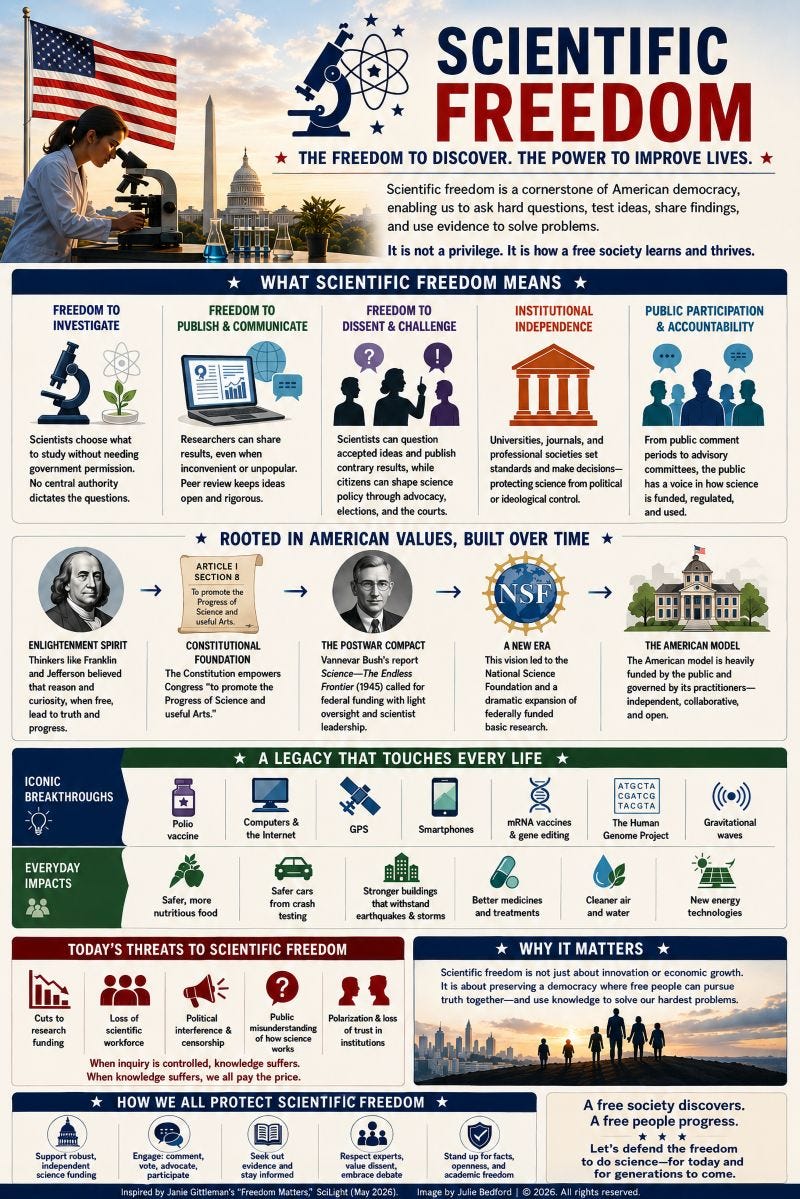
Scientific freedom does not appear by name in the Constitution. But over more than two centuries, the United States has built a system that makes scientific work remarkably free compared with most of human history and much of the modern world. That system is worth understanding, because it is both more fragile and more consequential than most Americans realize. Scientific freedom is not one single right. It is a bundle of interlocking liberties that, together, allow a society to learn things it did not already know.
It includes the freedom to investigate. Researchers can choose what to study without government permission. A biologist can examine aging. A physicist can chase an anomaly in particle data. No central authority hands down a list of approved questions. It includes the freedom to publish and communicate. Scientists can share findings even when they are inconvenient, uncomfortable, or politically unwelcome. The peer-review process disciplines those arguments while keeping them open, a structure some scholars have compared to democracy itself: imperfect, but better than any alternative tried so far. It also includes the freedom to dissent. A graduate student can publish data that overturns a textbook. A researcher can challenge a dominant theory, and citizens can participate in shaping science policy through advocacy, elections, public comments, and the courts. Science policy is not decided in a sealed room by experts. It is contested by everyone from researchers to concerned parents.
The American approach did not emerge by accident. Benjamin Franklin’s experiments with electricity made him internationally famous. Thomas Jefferson was an amateur paleontologist and agricultural experimenter. The Constitution itself carries the imprint of this sensibility in Article I, Section 8, which empowers Congress “to promote the Progress of Science and useful Arts.”
Enlightenment thinkers believed that human reason, given freedom to operate, would tend toward truth. Some scholars have argued that freedom of speech itself implies a right to conduct research, making inquiry not a privilege governments grant, but a natural human activity they should protect.
The decisive institutional moment came after World War II. Vannevar Bush’s landmark report, Science—The Endless Frontier, proposed that the federal government fund basic research generously but govern it lightly, channeling money through universities and allowing scientists to help decide which projects deserved support. Bush’s vision became the blueprint for postwar American science, leading to the founding of the National Science Foundation and a dramatic expansion of federal research funding. The result was unusual: a national scientific enterprise funded heavily by the public but governed largely by its practitioners. It has flaws, but it also has an extraordinary track record.
It is easy to take the achievements of American science for granted because we live inside them. The polio vaccine, the first practical computers, the internet, GPS, and the smartphone in your pocket all came out of American labs. So did mRNA vaccines, gene editing, the Human Genome Project, and the detection of gravitational waves. Many of these advances were direct dividends of the postwar funding compact.
Less dramatically, but just as importantly, American science has reshaped daily life in ways most people never notice. Food stays fresh because of advances in food science. Cars are dramatically safer because of crash testing and materials science. Buildings survive earthquakes and storms because engineers learned, often through painful failures, how to build better.
None of this was inevitable. The Soviet Union devastated its own biology in the mid-twentieth century by enforcing the ideology of Trofim Lysenko, who rejected modern genetics on political grounds. Thousands of mainstream biologists were dismissed, imprisoned, or worse, and the renowned geneticist Nikolai Vavilov died in prison in 1943. Soviet biology took decades to recover. The problem was not a shortage of talent. It was a shortage of freedom. That lesson matters because scientific freedom is not only about what happens inside laboratories. In the American sense, it extends to all of us. Science needs funding, regulation, public legitimacy, and democratic accountability.
Federal research budgets are set by Congress, which means they are shaped by elected officials who answer to voters. When constituents push for more cancer, Alzheimer’s, or climate research, those priorities filter into the system. It is slow and imperfect, but it is responsive. When the FDA considers approving a drug, or the EPA considers a new pollution standard, federal law generally requires a public comment period. Anyone can submit comments that agencies must legally consider. Hundreds of federal advisory committees—on vaccines, nuclear safety, oceanography, and more—hold meetings open to the public.

State and local governments matter too. States fund universities. School boards shape science education. City councils make decisions about water, air, and public health. All are places where citizens can show up and be heard. That openness is part of the system’s strength. It is also part of what makes it difficult.
A system this open can be loud, contradictory, and frustrating. Scientists often know things the public does not, and their technical judgments deserve weight. But whether to mandate a vaccine, regulate emissions, or approve a new technology involves value judgments beyond technical expertise. This is part of what sociologist Gil Eyal calls the “crisis of expertise”: society depends more and more on experts even as public confidence in expertise becomes more contested.
There is also tension between openness and security. Research on dangerous pathogens, artificial intelligence, or advanced computing raises legitimate questions about what should be shared and what should be restricted. There is tension between curiosity-driven and applied research. Lasers came from theoretical physics. The internet emerged from unexpected uses of military research. Yet there is constant pressure to fund only work with obvious near-term payoffs. And there is tension between scientific consensus and public skepticism. Sometimes the public is right to push back. Sometimes it is wrong. Telling the difference in real time is genuinely difficult.
Science Policy: Where Citizens Come In
For most of the past 80 years, Americans have treated scientific freedom the way they treat indoor plumbing: as a permanent feature of the landscape rather than something that requires active maintenance. Surveys make the disconnect plain. In early 2026, a Pew Research Center survey found that most Americans still see government investment in scientific research as worthwhile. Yet the institutions that produce that research have been undergoing the most significant upheaval since the postwar funding compact was built.
In 2025, federal research funding and staffing faced major disruptions. The Association of American Universities reported sharp declines in NIH and NSF awards compared with recent years. Federal science agencies also saw significant workforce losses, according to analyses from the American Institute of Physics and the Partnership for Public Service. The administration’s fiscal year 2026 budget request proposed deep cuts to major science agencies, including NSF, NIH, and NASA.
Congress, in a notable bipartisan move, rejected the steepest cuts and held most agency budgets roughly flat into 2026. But the episode revealed how brittle the research enterprise had become beneath its reputation for stability. The lesson is not partisan. Administrations of both parties have pressured science when findings proved inconvenient. The lesson is structural. A system built on the assumption that funding, hiring, and topic selection will remain insulated from political swings cannot survive on that assumption alone.
Most Americans, asked, will say they value science. Far fewer can name how federal research is funded, how peer review works, what the National Science Foundation does, or how to submit a public comment on a proposed regulation. The freedom to participate in science policy is real, but unexercised freedoms tend to atrophy.
Recent research on freedom of scientific inquiry and democracy, along with the global Academic Freedom Index, warns that academic freedom and scientific inquiry are increasingly under pressure worldwide, including in established democracies. The pressures are not unique to any one country or any one political moment. That is why the basic questions are still worth asking.

Why does it matter that a researcher can choose her own questions? It’s because nobody knows in advance which question will matter. The researchers who developed mRNA technology spent decades on work many people thought was a dead end, until it became the foundation of vaccines that saved millions of lives during a pandemic.
Why does it matter that findings can be published freely, even when inconvenient? Due to the fact that the alternative is a world where science becomes a tool of whoever holds power, and truth becomes whatever the powerful want it to be. The Lysenko episode shows the human cost.
Why does it matter that citizens can shape science policy? It’s because science does not tell us what to value. A democratic society that hands all of those choices to a small group of experts has stopped being fully democratic. A society that ignores its experts and acts on wishful thinking pays heavy prices, sometimes for generations.
The American system of scientific freedom is not just about gadgets, cures, or economic growth. It is about a larger vision of what human beings are capable of: that ordinary people, given the freedom to ask questions and the patience to follow the answers, can better understand the universe they live in, correct old errors, and discover new truths. They can do this together, across disagreements and generations, in a long collaborative effort that no single person or government controls.
The freedoms that make American science possible are part of a larger bet: that free people, thinking and working together, can figure out hard things. So far, that bet has paid off in ways the founders could not have imagined. Whether it keeps paying off depends in part on whether Americans understand what they have, and whether they continue to exercise the freedoms that protect it. Scientific freedom may not make the usual list of American liberties. But it belongs there.
About the Author
Dr. Janie Gittleman is an occupational epidemiologist, public health policy advocate, and researcher in global disease surveillance and analysis. As the former Chief of Safety, Health, and Environmental Compliance at the Defense Intelligence Agency, she oversaw health and safety policy development, operations, and emergency response worldwide. She previously served as Executive Director of Global Health Technology for the ManTech Corporation, the Association of Occupational and Environmental Clinics, and as Associate Director for the National Construction Center.
Janie has served on committees for the Centers for Disease Control and Prevention, the National Academies, the World Health Organization, and Johns Hopkins School of Medicine. A former Epidemic Intelligence Officer and representative on the American Public Health Association Science Board, Janie has published extensively in occupational safety and health.
 |
|